
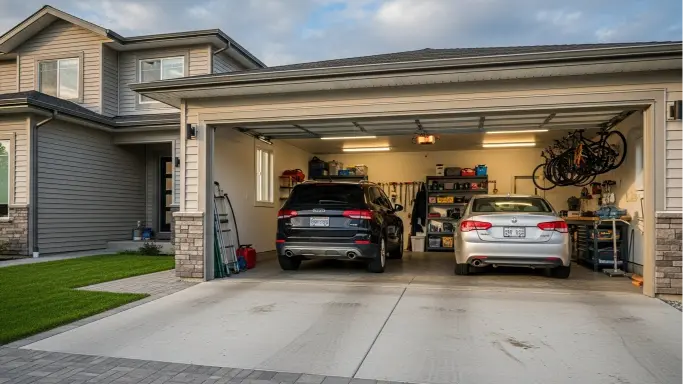
When planning a garage or buying a home, a common question is: how big should a two-car garage be? The simple answer is that most two-car garages range from 20×20 feet to 24×30 feet (about 400–720 square feet).
This gives enough room for two cars and some extra space for walking around, opening doors, and storing items like bikes, lawn equipment, or a small workbench. In this guide, we’ll show you the standard sizes, what fits comfortably, and how to choose the right garage for your needs now and in the future.
What Is a Two-Car Garage and Why Size Matters
A two-car garage is just what it sounds like, a garage for two cars. Most people imagine cars parked side by side, which is the most common way. But the size of the garage matters for more than just fitting the cars.
Think about your daily routine. You come home, park, and open your car door. If the garage is too small, your door might hit the wall or the other car. That gets frustrating fast. If you have kids, they need extra space to get out with backpacks or sports gear. And where will you put trash cans, holiday decorations, or tools? The right garage size gives you space to move and makes life easier every day.
Common Two-Car Garage Sizes:
- 20×20 feet = 400 square feet (tight but workable)
- 22×22 feet = 484 square feet (a bit more comfortable)
- 24×24 feet = 576 square feet (the sweet spot for most people)
- 24×30 feet = 720 square feet (plenty of extra space)
What Does Two-Car Garage Really Mean in Real Life?
When people say “two-car garage,” they usually mean a garage big enough for two normal cars to park side by side comfortably. But cars today aren’t the same as they were 20 years ago. SUVs and trucks are bigger, and even regular cars are wider now.
Standard Side-by-Side Parking Configuration
The side-by-side setup is what most of us picture. Two cars parked next to each other, both facing the same direction. This is the most popular layout because it’s simple and both cars are easy to get to.
To use a two-car garage comfortably, you need enough space so car doors can open without hitting each other. A car door usually needs about 2 to 3 feet to swing open. If your garage is only as wide as the two cars side by side, you won’t be able to get out easily, definitely not fun.
Most people find that 24 feet wide gives enough room to park two regular cars and still move around comfortably. A 20-foot-wide garage can work with smaller cars, but it will feel tight.
Attached vs. Detached Two-Car Garages
Attached garages are connected to your house. You can walk from your car straight into your kitchen without going outside, great on rainy or cold days. They usually follow the same size rules as detached garages, but you might have less choice about where to put them since they have to fit with your house.
Detached garages stand alone on your property. You can place them wherever you like and design them how you want. Some people make them bigger because they use them for more than just cars, like a workshop or extra storage. The sizes are similar to attached garages, but you usually have more room to go bigger if your property allows it.
Uses Beyond Parking
A lot of people use their garage for more than just parking cars. If your garage is 24×24 or bigger, you can add a workbench, hang bikes on the wall, store seasonal items on shelves, or even have a small workout area. The key is to think about how you want to use your garage, not just for parking, but for storage, hobbies, or other projects.
Common Two-Car Garage Dimensions (Quick Reference Guide)
Let’s break down the most popular sizes
| Width × Depth | Square Footage | Best For |
| 20×20 feet | 400 sq ft | Two compact or small cars, minimal storage |
| 22×22 feet | 484 sq ft | Two average sedans, some wall storage |
| 24×24 feet | 576 sq ft | Two standard cars or one truck/SUV + one car, good storage space |
| 24×30 feet | 720 sq ft | Two large vehicles, workshop area, or lots of storage |
| 28×28 feet | 784 sq ft | Two trucks/SUVs comfortably, plus extras |
These dimensions measure the inside of the garage, not including the thickness of the walls.
Understanding Garage Width, Depth, and Ceiling Height
You need to think about all three dimensions, not just floor space.
Garage Width — How Much Space Do Two Cars Really Need?
Width matters because it controls whether you can open car doors. A typical sedan is about 6 feet wide. SUVs and trucks are closer to 7 feet. Two 6-foot cars side by side take 12 feet—but you can’t walk between them or open doors.
That’s why 24 feet is popular. It gives you space for two cars plus room for doors, walking, and maybe wall shelves. You can squeeze by with 20 feet if your cars are small, but 24 feet feels much better. If you have trucks or large SUVs, consider 26 or 28 feet wide. Those extra feet help when loading cargo or opening doors fully.
Garage Depth — Parking, Storage, and Workspace Needs
Depth is how far back your garage goes. Most cars are 15 to 18 feet long. Trucks and SUVs run 18 to 20 feet. A 20-foot-deep garage gives just enough room to park, not much more.
Depth matters if you want to walk around your cars or add a workbench at the back. A 24-foot or 30-foot depth lets you park and still have space behind for storage or work area. Some people go even deeper, 32 feet for serious workshop space or to park boats or RVs behind their cars.
Ceiling Height — What’s Standard and When to Go Taller
Most garages have 8 or 9-foot ceilings. That’s tall enough for regular cars and leaves room for garage door openers and overhead storage.
If you have tall vehicles like trucks with lift kits, full-size SUVs, or vans, you might need 10 or 12-foot ceilings. Higher ceilings also give more storage options and make the space feel less cramped. Taller garages cost more to build because you need more wall materials, but they’re worth it if you need the clearance.
Two-Car Garage Layout Options and Parking Configurations
Not all two-car garages have side-by-side parking. You have options based on your property and needs.
Side-by-Side Layout (Most Common)
Both cars park next to each other, facing the garage door. This is the classic setup most people picture. This works best with at least 20 feet of width, but 24 feet is more comfortable. Both cars are equally easy to reach.
Tandem Garage Layout (Front-to-Back Parking)
One car parks behind the other, front to back instead of side by side. This works if you don’t have much width but have extra depth. Or if one car rarely moves, you can park the daily driver in front. It saves space but can be annoying when you need the back car.
Offset or Custom Layouts
Some properties don’t have room for a standard rectangle. Maybe your lot is narrow or oddly shaped, or you’re in an older Richmond neighborhood with tight space. You can design custom layouts where cars angle slightly or where one spot is wider than the other. These take more planning but can work in difficult spaces.
Choosing the Right Garage Size for Your Vehicles
Your vehicles are what you’re building for, so measure them first.
Recommended Garage Sizes by Vehicle Type
Compact cars (Honda Civic, Toyota Corolla):
- About 5.5 to 6 feet wide and 14 to 15 feet long
- Fit comfortably in 20×20 or 22×22
Standard sedans (Honda Accord, Toyota Camry):
- About 6 feet wide and 15 to 16 feet long
- Need 22×22 minimum, 24×24 is better
SUVs and trucks (Ford F-150, Chevy Tahoe):
- 6.5 to 7 feet wide and 18 to 20 feet long
- Need 24×24 minimum, 24×30 is better
Two trucks or large SUVs:
- Go with 26 or 28 feet wide
- Depth of 24 to 30 feet
Measuring Your Vehicles Before Finalizing Garage Size
Measure your actual cars. Check the width (including mirrors), length, and height. Write these down. Add space for getting in and out. Figure at least 2 to 3 feet on each side of each car for doors. Add a few feet front and back so you’re not squeezing in tight. Think about your next vehicle too. If you might buy a truck in a few years, plan for that now. Building the right size from the start is cheaper than expanding later.
Functional Zones Inside a Well-Planned Two-Car Garage
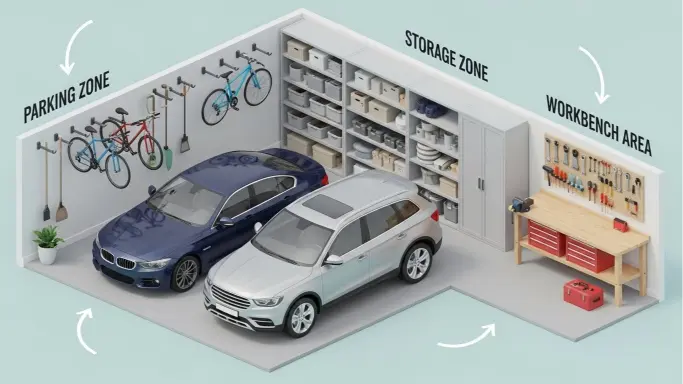
A good garage has different areas for different uses.
Parking Zone
This is where your cars sit. You need room for the cars plus clearance all around—at least a couple feet on each side and some space front and back.
Storage Zone
Use the walls and back space for storage. Shelving, pegboards, and cabinets hold tools, sports equipment, and seasonal items. Overhead racks hang from the ceiling and hold bins or things you don’t need often. Just make sure you have enough ceiling height so racks don’t hit your garage door or your head.
Workbench or Hobby Area
A 24×24 or bigger garage has room for a work area. A workbench along one wall gives space for projects and DIY work. Even a simple 6-foot bench adds lots of usefulness.
Planning for Future Needs
Think ahead. Maybe you don’t need much storage now, but what about when you have kids with bikes and sports gear? Or if you take up woodworking as a hobby? Building slightly bigger now gives you flexibility later. It’s easier to add shelves to an existing garage than to expand the whole building.
Planning and Building a Two-Car Garage in Richmond, VA
Building in the Richmond area has some local considerations.
Local Building Codes, Permits, and Zoning Considerations
Check with Henrico County or the City of Richmond about permits and zoning before building. Every area has rules about how far your garage must be from property lines, how tall it can be, and building code requirements.
You’ll need a building permit. An inspector will check your foundation, framing, and electrical work. Building without permits causes problems when you sell your house later. Some neighborhoods have homeowners associations with rules about garage design, color, and placement. Check all this before you start.
Foundation and Flooring Options
Most garages sit on a concrete slab. This is the most common and practical choice. A good concrete slab with proper drainage lasts for decades and handles vehicle weight without problems.
The slab needs to be at least 4 inches thick and properly reinforced. Good contractors compact the ground and make the slab level with a slight slope toward the door so water drains out. Some people add epoxy coating or garage floor paint to make concrete look nicer and easier to clean. These are extras but make your garage feel more finished.
Cost of Building a Two-Car Garage (What to Expect)
Building a garage is a big investment. Cost varies based on several factors.
Average Cost per Square Foot
In the Richmond area, building a basic two-car garage runs between $50 and $150 per square foot. A simple detached garage with basic finishes costs around $50 to $70 per square foot. An attached garage with nice finishes, insulation, and quality materials runs $100 to $150 per square foot. For a 24×24 garage (576 square feet), expect roughly $28,000 to $86,000. For a 20×20 (400 square feet), maybe $20,000 to $60,000.
These are estimates. Your actual cost depends on your choices.
What Increases or Decreases Total Cost
Higher costs:
- Attached garages (more complex)
- Quality materials (brick, stone, special siding)
- Finished interior with drywall and paint
- Insulation and climate control
- Electrical work (outlets, lights, openers)
- Plumbing (if you want a sink)
- Custom features (extra windows, special doors)
- Difficult sites (slopes, poor soil)
Lower costs:
- Detached garage with basic design
- Standard materials (vinyl siding, asphalt shingles)
- Simple concrete slab
- Minimal electrical work
- No insulation
- Building it yourself (if you have skills)
Final Recommendations
If you have two small cars and don’t need much storage, a 20×20 or 22×22 garage can work. It’s a bit snug but saves money. For two average cars and some storage, 24×24 is a popular choice because it’s comfortable without being too big. If you have trucks, SUVs, or want space for a workshop, consider 24×30, 26×28, or 28×30, the extra room is worth it. If your budget or space is tight, 22×22 is the minimum, but it’s smart to plan for a bigger garage you might need in the next 10 years.
Ready to Build Your Perfect Two-Car Garage?
At LHC Services, we bring over 25 years of experience in home remodeling and construction to help you plan and build the garage of your dreams. Whether you need a cozy 20×20 garage for two small cars or a spacious 28×30 workshop-ready garage, we’ll help you choose the perfect size, layout, and features for your needs. Schedule Your Garage Consultation
From attached or detached designs to custom storage solutions and functional zones, we handle every detail so you can enjoy a garage that fits your lifestyle.